WHAT IF CHILD LABOUR WAS LEGAL IN INDIA?
ABSTRACT
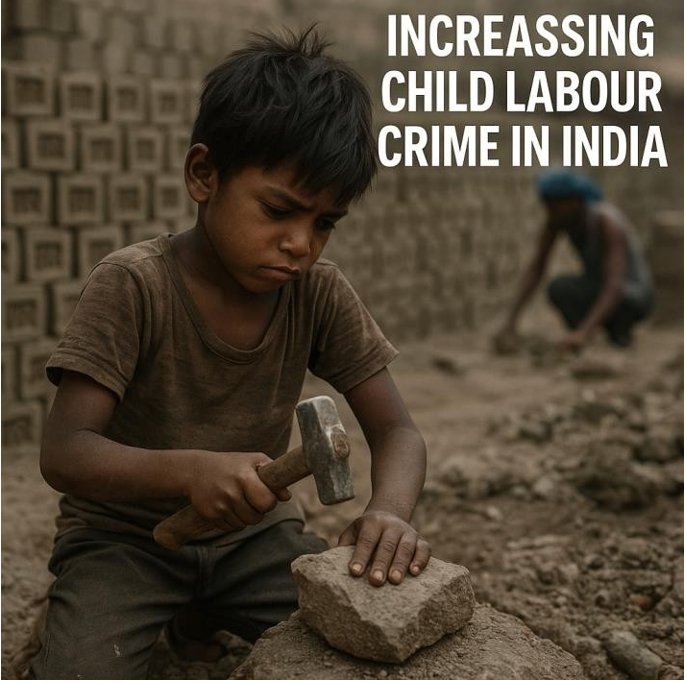
Child labour is one of the most heinous crimes in India and it is prohibited by our Constitution. Children maybe driven into work for various reasons. Child labour is basically the employment of children of less than a legally specified age which deprives them of their education and childhood. The International Labour Organization (ILO) defines child labour as a “ work that is mentally, physically, morally or socially harmful to their children; and/or interferes with their schooling by: depriving them of the opportunity to attend school; obliging them to leave school prematurely; or requiring them to attempt to combine school attendance with excessively long and heavy work ”. As we are aware that not all forms of the work that are undertaken by the children would be considered as child labour. Each and every country defines their specific laws, rules and regulations for condemning child labour , there is variance amongst countries to decide if the work done comes under child labour. This actually depends on the age of the children, type of the work they perform, the number of hours they work and most importantly the conditions they work under and whether it interferes with their schooling. In this sense, we can say that child labour is open exploitation of children, it deprives the children of their basic necessities like
CAUSES OF CHILD LABOUR
- Poverty: Poverty is the most dominant and the most significant factor that causes child labour. India is a developing nation but two-thirds of its population lives in poverty. Poverty has caused people to do things which are not acceptable, this includes thefts, gang wars and most importantly child labour. Due to this people living in rural or maybe sometimes urban areas have to find ways for their survival. Poor people hence rely on their children because they are their only asset and their only source of livelihood and income.
-
Unemployment:
 High levels of unemployment result in child labour as well. There
are
thousands of people in the country who remain unemployed every single day. People are
unemployed and hence ask the children in their families to work. This is because many
industries and factory owners employ children for their petty works. Even children are asked
to work and run errands for shops or showrooms.
High levels of unemployment result in child labour as well. There
are
thousands of people in the country who remain unemployed every single day. People are
unemployed and hence ask the children in their families to work. This is because many
industries and factory owners employ children for their petty works. Even children are asked
to work and run errands for shops or showrooms.
- Lack of Educational Resources: Thousands of children in our country are still deprived of adequate educational resources. There are many villages where there are still no proper facilities for education. Children are even deprived of basic schooling which is perhaps a necessity in our country. Many rural and backward areas have no resources for education or even primary education because of the corruption that is done by politicians and officials who keep the funding to themselves instead of utilizing it for the fulfilment of educational needs.
- Lack of Awareness: Till this date even, many people are still not aware of the consequences of practising child labour, they are not even aware of the laws, rules and regulations that have been made for child labour. There are people who are still following this practice blindly just for the sake of money.
- • High Population: India’s population is second highest in the world. People in rural areas have no birth control and hence have more than 10 kids. That’s why people engage their children in child labour ,so that they can feed their families.
CONSEQUENCES OF CHILD LABOUR
According to UNICEF, the consequences of Child Labour are staggering “ Child Labour can result in extreme bodily and mental harm, and even death. It can lead to slavery and sexual or economic exploitation. And in nearly every case, it cuts children off from schooling and healthcare, restricting their fundamental rights and threatening their futures ”. Child labour plays with the lives of younger children. Children working under heavy and exploitative work situations usually suffer from anxiety and depression. They are triggered into abusive environments that’s why they develop destructive habits like smoking, drinking and even drug abuse. Not only mentally but the children also suffer physically when they are forced to work in hazardous conditions. Both the mental and the physical health of the child is affected due to child labour and that often continues into their adulthood. These can also include long term health issues that are caused due to the abuse, injuries or malnutrition that the children have gone through. Working excessive hours, exposure to hazardous materials like explosives, toxic chemical fertilizers and unhealthy toxins etc, risk of injuries, isolation from friends and family, exposure to dangerous environments and lack of adequate protection equipments are the intangible consequences of working as a child labour. Child labour destroys the child’s career and even his mental and physical abilities to
Consequences of child labour by UNICEF engage in any work, it deprives the children of their childhood – that is simply the age of having fun and learning new things.
LAWS, SCHEMES AND RULES AND REGULATIONS RELATED TO CHILD LABOUR IN INDIA
Indian Government has provided strict rules and regulations against child labour in the country. Our Constitution stands committed in the elimination of child labour and hence lays down the various laws for the protection of children against child labour.
Article 24: Prohibition of hazardous employment of children No child below the age of 14 years shall be employed in any work in a factory or mine or be engaged in any other hazardous employment
Article 21A: The Right To Education The State shall provide free and compulsory education to all the children from the age of 6 to 14 years in such manner as the State, by law, may determine.
3. he Constitution of India
4. he Constitution of India
Article 39: The State shall, in particular, direct it’s policy towards securing:- (e) that the health and strength of workers, men and women, and the tender age of children are not abused and that citizens are not forced by economic necessity to enter avocations unsuited to their age of strength.
The Child And Adolescent Labour (Prohibition And Regulation) Act, 1986 This act lays down the rules and regulations regarding the practice of child labour in India. Children below 14 years of age are prohibited to work in hazardous conditions and occupations . It aims to eradicate any kind of child exploitation. Both the occupations and processes that are prohibited are mentioned under the Schedule in Part-A and Part-B of this act. This act in total prohibits 13 occupations and 51 processes for the employment of children below 14 years of age. It also lays down important guidelines for the employers who engage in the employment of children below 14 years of age. The employer has to ensure that the child does not work more than 6 hours and he has to provide educate provisions of health and safety of the child employees. The basic facilities including good hygiene and basic necessities drinking water, clean toilets , waste disposal and ventilation have to be taken care of. According, to the rules of this act the production of age certificate of the child employee is also necessary.
The Child Labour (Prohibition And Regulation) Amendment Act, 2016 This act was amended in The Constitution in the year 2016. It now focuses on the prohibition of engagement of children in all occupations and also prohibits the engagement of adolescents in hazardous occupations and processes. This amendment was brought up to ensure stricter punishments for the employers who violate the rules and regulations of this act.
The Child Labour (Prohibition And Regulation) Amendment Rules, 2017 The Indian Government decided to make further amendments in the main act after the extensive consultation with its officials and the provisions are as follows :
5 The Constitution Of India
6 Rules and regulations for condemning child labour
- A broad and specific framework for prevention, prohibition, rescue and rehabilitation of children and as well as adolescent workers.
- Clarity on issues related to family enterprises.
- Safeguards for creative workers or artists that has been permitted to work under this act, with respect to working hours and working conditions.
- Set of specific duties and responsibilities for law enforcement agencies to ensure effective implementation and compliance of this act.
ILO Core Conventions Related to Child Labour
The International Labour Organization under the United Nations tends to work and set labour standards, develop various policies and lay down the programs stating the conventions promoting decent work for all men and women. It lays down 8 conventions against bonded labour exploitation. Two of these core conventions are directly related to child labour and India has ratified both of these core conventions of the International Labour Organization in the Indian laws related to child labour.
- ILO Convention No. 138 (Minimum age): This is concerned with the minimum age of entry to work or employment. Under this each country has to ensure the specification of minimum age for working, not to be less than the completion of compulsory schooling . Every country also has to ensure the creation of policies related to child labour and its abolition. It also demands a guarantee that the minimum age of working under unprotected environments should not be less than 18 years.
- ILO Convention No. 182 ( Worst Forms of Child Labour): This is referred to as the basic or fundamental human rights by the ILO which states that the term ‘child’ is applicable to all the persons under the age of 18. Worst form of labour includes all the illegal and explicit activities including slavery of children, trafficking of the children, forced or compulsory labour , child prostitution, pornography and using the children for drug trafficking.
The National Child Labour Policy, 1987 This policy came in action for condemning the problem of child labour. It includes a legislative action plan which focuses on the development of children wherever possible. This scheme was enforced in 1988 to eradicate child labour. The Legislative Action Plan was brought up for the strict enforcement of the child labour act in India. This policy purely focuses on rehabilitation of children working in exploitative and hazardous occupations and processes. The children working under any of these conditions are to be withdrawn and then to be put up in special schools to enable their education.
UNICEF India
UNICEF ( United Nations International Children’s Emergency Fund ) in India works towards strengthening child protection systems, ending child marriage, protecting children on the move, preventing child labour and violence against children. It also focuses on the implementation of legislation and even the promotion of practices that protect the children from violence, exploitation and abuse. UNICEF India works with the government to provide well-established alternatives options for child labour.
Penalties and Fines For Child Labour
Any person who employs a child below 14 or child between the age of 14 and 18 years in any hazardous occupation or processes then they can be punished with the jail time of between 6 months and 2 years. They can also be imposed with the fine of Rs. 20,000 and Rs. 50,000.
India is trying it’s best to eradicate and remove child labour for which it also has to tackle many others problems like poverty, lack of educational resources and even high levels of unemployment. To ensure that child labour is removed from the roots of this society, India has still a long way to go. Children still suffer from this hineous practice and there is still a lot of development required for condemning this wholly.
WHAT IF CHILD LABOUR WAS LEGAL IN INDIA?
Even though child labour has been banned in India and is considered as one of the most heinous crimes here, people still are following this practice blindly. Sometimes it is the circumstances that makes them do so but sometimes it’s the greed and love for money. You will still find thousands of children working in a factory or even at house help. If you take a step out ,you will definitely find one or the other child working on a shop, some are found working as cobblers on the streets, some working as servants and the list is endless. So the topic of my blog which certainly asks that what if child labour was legal in India? You may definitely know from the inside that the legalization of child labour is really not a matter of fact here . It is the awareness that matters. The awareness which has to be brought up amongst each and every citizen of India, maybe literate or illiterate, maybe be poor or unpoor, may be in rural areas or in the urban areas. Child labour being practiced although it is abolished is an utmost visual that depicts what would happen if India legalised the practice of child labour. Children would be working in hazardous conditions, exploited by their employers, they would be deprived of their basic schooling and education, it would destroy their mental and physical abilities, they could be subject to prostitution, trafficking and even drug abuse. The list seems to be endless. In the recent reports of the year 2017 it was said that some of the recently enacted laws have legalized child labour in many sectors in India, a representative of an Indian organization that works against sex trafficking has told the members of the UN general assembly. Ruchira Gupta representing Apne Aap Women Worldwide, an award-winning organisation that works against sex trafficking in India, in her address to a high level meeting of the general assembly she said, “ there are two laws which are very problem attic and will have a very dangerous impact on poorest of the poor girls. One these loss was passed in September last year, she said in her remarks. She further added that the law that has been introduced has legalised child labour in my country in many sectors like family-based enterprises and audio-visual entertainment. It has also removed the ILO-IPEC list of hazardous Industries that children should never be employed in ”. She said that there will be creation of data that will show the decrease in human trafficking in India but it will definitely increase child labours and exploitation of child workers in India. This also shows that the developmental processes of our country are also encouraging the number of child labours . So, if anyhow there was legalisation of child
Legalization of child labour labour in India then the youngsters, the children, the future of the country would have suffered the most, the consequences would have been triggering and the children who are going to become the future assets of the country would have been deprived of all their basic necessities from living their childhood to having basic education. Legalization of child labour would have also caused illiteracy and high crime rates in the country.
MY PERSPECTIVE
From my perspective, India has still long way to go. We still have to take efficient and strict steps to eradicate child labour from our society. Each and every child on this earth should be ensured of his legal right of basic education and compulsory schooling, no matter what the circumstances are. Families and Guardians of the children should also ensure that their child is provided with all the basic necessities that he or she requires for the accomplishment for their beautiful childhood. The Indian Government should impose more stricter laws and penalties against those who support the practice of child labour in India. Parents of the children should be made aware, that the children are not sent to work in any hazardous conditions for money or livelihood rather they should find more and more opportunities for themselves to earn their source of income. This can only be ensured if the Indian government also eradicates the problem of high levels of unemployment in India. But the most important of all these problems is the eradication of poverty. Poverty is one of the main causes of child labour and hence it is necessary for the Government of India to focus on the eradication of poverty from the roots of society which will automatically end child labour in India.